A Practical Guide to Storytelling for Ministry Leaders
Storytelling training for ministry marketing begins with understanding why story moves the human heart. You know a good story when you hear one because of how it makes you feel. The best stories touch secret places in your heart and inspire you to be a better person.
As a content creator for the body of Christ, do you know the elements of a story needed to persuade your audience to join you in the Great Commission?
Many ministries work tirelessly to inform and educate, yet still struggle to inspire meaningful action. They publish updates. They share sermons. They communicate strategy. But engagement feels inconsistent.
It’s not because the mission lacks power. It’s because information alone rarely moves the human heart.
From Genesis to Revelation, God reveals Himself through story. Creation. Fall. Redemption. Restoration. Scripture does not unfold as bullet points. It unfolds as narrative — conflict that leads to transformation.
In this storytelling training for ministry marketing, we’ll define the essential elements and structure of a short story so you can intentionally craft content that spreads awareness, deepens engagement, and strengthens your ministry marketing strategy.
Table of Contents
What Is a Story in Ministry Communication?
Well-meaning ministries that tell us storytelling doesn’t work to inspire their ministry partners and participants are not really telling stories at all. Instead, they are educating their audience with lessons, or informing them with facts.
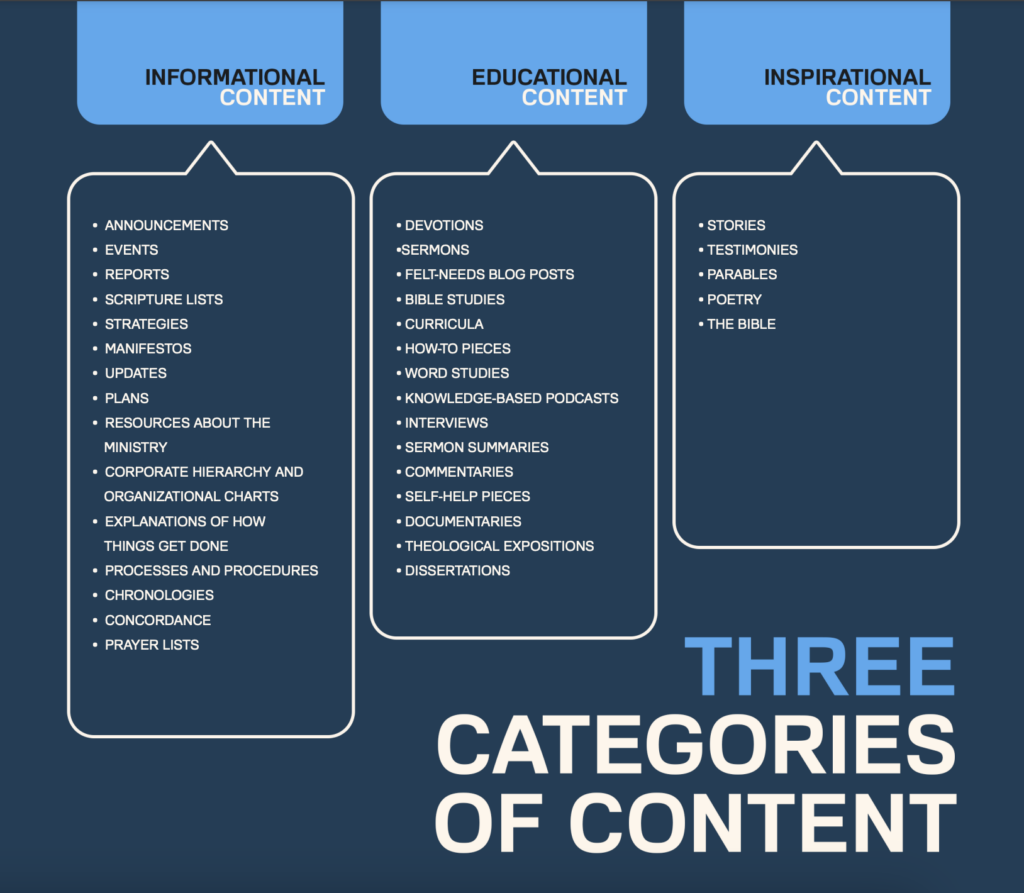
There are three major categories of content: informational, educational, and inspirational. Each category is effective when used for its relevant purpose and benefits, but one is more powerful than the others to change lives and inspire action.
In the next section, we will define what types of content belong in each category so you can intentionally craft the most relevant format to accomplish your goals. When you understand the difference, you can align your content with the specific response you want from your audience.
Informational Content in Churches and Nonprofits
Informational content feels like news. It’s a printed or recorded report, chronology, or discussion of events. If the purpose of the content is to advise or discuss when, where, or who, then it’s probably informational.
Ministry leaders are doing a great job of keeping their audience informed of what the ministry is doing and how they can help. For example, you may share a chronology of events that took place during a human trafficking rescue. You may explain the values behind your corporate manifesto. Informational content also includes plans for next year’s strategies or a summary of this year’s results.
Here are a few examples of informational print, web, audio, or video content in ministry.
- Announcements
- Events
- Reports
- Scripture Lists
- Strategies and models
- Manifestos
- Updates
- Plans
- Resources about the ministry
- Corporate hierarchy and organizational charts
- Explanations of how things get done
- Processes and procedures
- Chronologies
- Concordance
- Prayer lists
Educational Content That Teaches and Disciples
Educational content is created to teach the audience something new or solve a problem. It may be a print or recorded step-by-step guide or how-to article. If the purpose of the content is to answer how or why, then it’s probably educational.
The ministry space is fantastic at providing resources and guidance to help their audience learn and gain a deeper understanding of Scripture. For example, you may publish a felt-needs blog post about five ways to overcome anxiety through faith. Many churches expand on a portion of last week’s sermon. You may interview a leader or a missionary.
Here are a few examples of educational print, web, audio, or video content in ministry.
- Devotions
- Sermons
- Felt-needs blog posts
- Bible Studies
- Curricula
- How-to pieces
- Word studies
- Knowledge-based podcasts
- Interviews
- Sermon Summaries
- Commentaries
- Self-help pieces
- Documentaries
- Theological expositions
- Dissertations
Inspirational Content That Moves People to Act
Inspirational content is crafted to reach the listener’s heart. It may make the audience cry, laugh, or motivate action. If the purpose of the print or recorded content is to evoke emotion, then it’s probably inspirational. That’s where storytelling comes in.
You may share a testimony of how a couple saved their marriage through a recent Bible study. Record a YouTube video of how a reluctant visitor accepted Jesus and chose baptism. A story doesn’t even have to be 100 percent true to be inspiring, so tell potential ministry partners a common scenario where their support saves a soul.
Here are a few examples of inspirational print, web, audio, or video content in ministry.
- Stories
- Testimonies
- Parables
- Poetry
- The Bible
Storytelling, by definition, is the most effective way to reach the unreached and engage the unengaged, because it is the mutual native language for all of humanity since the dawn of time.
God wired us for story. That’s why He is the Alpha and the Omega. He always was, always is, and always will be. He’s been speaking to us through story since Genesis 1:1 and Adam and Eve. When Jesus was on earth, He always spoke to the people through story.
He was speaking the word to them with many parables like these, as they were able to understand. He did not speak to them without a parable. Privately, however, he explained everything to his own disciples.
Mark 4:33–34, ESV
The ministry space is in a state of story poverty, which means the Church needs to tell real people’s stories of transformation more often. We believe this is in part because people do not understand what a story really is.
We’re here to change that, because whether it’s a life-altering salvation story, or a snippet of everyday life with Jesus, every testimony highlights the transformative power of God and brings hope to those who are struggling. You can even tell fictional stories that carry relatable themes for your ministry. As long as the story points back to the Gospel message, it will always accomplish what God intended.
We’d like to illustrate the impact and differences between informational, educational, and inspirational content through an example.
Why Story Outperforms Information: A Lion Conservation Example
Let’s consider a nonprofit organization with a mission to save the declining lion population in Africa. As part of their efforts, they either create or support films to show people the beauty and majesty of the animals while bringing awareness of the big cats’ struggles. Their goal is for people to fall in love with the animals so they will support efforts to save the lion population from further decline.
Consider the following three types of content either created or supported by our nonprofit.
- An infomercial about the history of the lions’ plight detailing how and why the population has declined, along with a request for donations to support the organization’s efforts to preserve the lions’ habitat.
- A National Geographic documentary about the lions of the savannah that teaches viewers how lions survive, how humans are making it harder for the cats, and what viewers can do to help.
- The nonprofit organization hosts a family night for people to come watch “The Lion King,” where they sell snacks and lion stuffed animals, and accept donations, including the option for symbolic adoption.
You can see the value in all three types of content. They are all video. All three give the audience a peek into the lions’ plight and include an ask to bring in funds. Every example has the power to inspire action and change lives.
But only one has made nearly twelve billion dollars in revenue and instilled three generations with love for lions.
As you read through the examples, you can feel the progressive impact. Consider your own experiences with each type of content. When you see an infomercial, you are moved for a moment. When you learn something new, you appreciate the topic’s importance. But when you watch a story, you feel what the characters feel.
Have you ever heard of a platinum collector’s edition of infomercials? The Lion King platinum collector’s edition sells for $50 on Amazon. And according to over 17,000 five-star reviews posted from as early as 2000 to last week, it’s selling.
Story engages emotion first. And emotion drives action.
When someone feels the tension of a character’s struggle, they instinctively want resolution. That is why storytelling increases generosity, volunteer participation, and long-term engagement.
Information tells people what is happening.
Story shows them why it matters.
When you lead with story, your educational and informational content becomes exponentially more effective.
Consider a church that shares weekly announcements about a new addiction recovery program. Attendance grows slowly. Now imagine that same church shares the story of a man whose life was restored through that program — his conflict, his turning point, and his new life in Christ. Engagement shifts because the story makes the mission personal.
Jesus used the same method throughout His entire ministry. He even shared His secret with us when the disciples asked Him why He always taught in parables. He explained that He opens our ears and eyes through story so we will be ready to understand.
This is why I speak to them in parables, because seeing they do not see, and hearing they do not hear, nor do they understand.
Matthew 13:13–15, ESV
We’ve defined the three types of content and shown you the power of using them in succession, starting with inspiration through storytelling. In the next section, we’ll talk about the elements of a short story you need to prime your audience for action, followed by how you can put it all together to create a daily content strategy.
The Essential Elements of a Story for Ministry Marketing
Just like in building a house, a story is defined by the elements and structures that create the desired result. You can’t build an engaging story with facts and timelines any more than you can build a sturdy house of straw and sticks. Just like a house of straw isn’t really a house, neither is a chronology of events a story.
Hollywood recognizes Robert McKee as one of the greatest storytelling coaches ever. He defines a story in three words: Conflict changes life.
A story has a conflict and a transformation that leads to a new life. That means there’s a character experiencing a problem within their environment. The story carries values, because by definition, a problem is wrong, and a solution is right. We identify with the character in their transformation, so we identify with their values and judge them as either right or wrong.
Stories also have a structure. If you recall the last time someone told you a story that kept back-tracking and jumping all over the place, you realize how a story without structure isn’t a story. It’s a headache.
If your goal is to inspire real participation — not just passive awareness — then you must intentionally include the structural elements that create transformation. Without them, you may have content, but you don’t yet have a story.
Elements of Story
- Character
- Setting
- Conflict
- Transformation
- New Life
- Inherent values
- Structure as a corresponding beginning, middle, and end
Now that you know the three categories of content, the purpose of each one, and the elements of a story, let’s discuss just one of many applications.
How to Build a Story-First Content Strategy for Your Ministry
Your new understanding of the three categories of content can apply directly to your church marketing strategy and overall ministry storytelling strategy. By planning a variety of informational, educational, and inspirational content, ministry leaders can provide a fresh structure to a powerful content strategy that invites new partners and helps your ministry thrive.
How Story Strengthens Your Ministry Marketing
Story is not just inspiration. It is a strategic communication tool.
When used consistently across your website, email campaigns, donor communication, and social media, storytelling clarifies your message and increases engagement.
Ministries that lead with story often see stronger donor retention, clearer messaging across teams, and deeper volunteer commitment.
Story is not a soft skill. It is infrastructure. When your story is clear, your website converts better, your emails resonate deeper, and your donors understand exactly why their partnership matters.
If your ministry needs help clarifying and implementing this framework, explore our Messaging Strategy services to align your story with structure and growth.
As a simplified example, if you publish two informational announcements, two educational pieces, and three testimonies every week, you will have content for every day. In this model, there certainly is enough going on in every ministry to execute a consistent daily content production strategy. As you get in a flow, continue to increase the frequency and quality of your content.
Why Storytelling Is Essential for Ministry Growth
If people don’t understand your mission, they cannot participate in it. Content production keeps your ministry visible, but storytelling keeps your mission compelling. Stay top of mind through consistent content that highlights real transformation and real people.
Before you say you’ve tried storytelling before and it didn’t work, review the content and consider if it included all elements of a story. Did you tell an actual story with a conflict, a change, and a new life? Or did you educate and inform with a lesson or an announcement?
Storytelling works in ministry marketing because it aligns with how God designed people to engage, respond, and participate in meaningful mission.
Frequently Asked Questions About Storytelling in Ministry
What makes a ministry story effective?
An effective ministry story includes a real character, a clear conflict, a turning point, and visible transformation. Without change, it’s an update—not a story.
How is storytelling different from sharing updates?
Updates report events. Stories reveal transformation. Updates inform. Stories move hearts.
Can fictional stories work in ministry?
Yes, if they illustrate Gospel-centered truth and reflect real human struggle. Parables are a biblical example of this (Mark 4:33–34, ESV).
How often should a ministry publish stories?
At least once per week. Consistency builds emotional memory and long-term engagement.
Do stories really increase generosity?
Yes. When people emotionally connect with transformation, they are more likely to participate, give, and remain long-term partners. Story builds relational equity, which strengthens donor retention and volunteer commitment.
What are the basic elements of a story?
Character, setting, conflict, transformation, new life, inherent values, and structure.
Strengthen Your Story. Strengthen Your Impact.
Most ministries don’t need more content.
They need clearer stories.
If you want to inspire generosity, deepen engagement, and move people toward mission, you need to master the elements of a story.
We created a simple, visual Elements of Story Infographic to help you apply what you just learned.
Download the infographic and use it as a weekly guide for collecting testimonies, structuring transformation stories, and strengthening your ministry marketing strategy.
Start with clarity. Then build from there.