A Practical Framework for Churches and Christian Nonprofits to Build a Sustainable Testimony Content System
Church storytelling is one of the most underused tools in ministry communication. For over a decade, we have worked with ministries and churches from all over the world, and for that same amount of time, we have struggled to get ministries to make storytelling a significant part of their communications strategy. There are a wide variety of reasons why storytelling is difficult for ministries, reasons why we simply don’t testify of God’s work in people’s lives. The problem is, those stories need to be told.
Sharing stories and testimonies has become a bit of a lost art in the Church, but sharing stories of God’s redemptive and transformative work in people’s lives is a great way to strengthen pre-existing audiences, and build new audiences, bringing attention to your ministry or cause in an attention-economy. Telling stories is a great way to engage with the culture at large in a way that’s contextually relevant to how people communicate.
In an effort to serve the church in this area of storytelling, we recently launched a service called Kingdom Stories, designed specifically for the Church, to help her tell more stories more often. It’s a done-for-you production, digital marketing, and testimony-driven content strategy that answers the question every ministry is struggling to answer, “how do we fill our annual content strategies?” If you’re not asking that question, this article either isn’t for you, or you should go take our “Why Story?” course to learn more on why you should care about this topic.
Now, it’s usually best business practice to avoid sharing intellectual property publicly, for free, for the world to see. But as a ministry, our heart motivation is to see God’s truth proclaimed. We want to see every Church on the face on the earth testifying of God’s transformative work, and so we are sharing the details and inner workings on this plan. Take it, replicate it, and start a story ministry in your church or ministry. Please, just share God’s stories. They deserve to be told, and the model I’m about to share with you will help you share those stories regularly. It’ll help guide your people in the practice of sharing their stories. Let’s get started.
Table of Contents
Testimony Content Strategy for Churches and Ministries
Just like in our article on Starting a Ministry Podcast, we’re going to start with strategy. You can’t build a house without first pouring a foundation. Without the foundation, the house doesn’t have a strong base to stand on. Here are some things to consider as you develop your strategy.
Define Your Church or Ministry Audience Before Creating Content
Now, I will admit that I’m not a huge fan of obsessing over the audience much, especially in a ministry context. I tend to lean towards sharing your beliefs, and allowing those beliefs to grab the attention of audiences who also share those same beliefs. But, I do see the value in at the very least discussing the audience in the strategy stage… in some circumstances. We won’t go into those circumstances today for the sake of brevity and focus, so for the sake of this article let’s just say that the audience should at least be considered and discussed.
Build a Consistent Church Content Calendar
Effective church storytelling depends on rhythm. How often are you going to post content? Are you shooting for a daily, weekly or monthly rhythm? Kingdom Stories offers two subscription options, two stories per month or four stories per month. The latter option will produce a weekly rhythm to publishing. You might decide that’s too much right now, but you can commit to sharing a single story per month. Whatever you decide, just know the algorithms prefer consistent content.
Identify Transformational Testimonies Within Your Ministry
The next step of your content strategy phase is determining who is going to share their story. If you’re creating this strategy in a local church context, it will likely be people from your congregation. If you’re a ministry, you might interview your beneficiary (what we at Reliant refer to as participant’s), or you might want to share the stories of your national partners. Regardless of whose story you’re telling, you need to ensure that the story you’re telling is actually a story of life transformation. The point of this strategy is to testify of heart change in Christ. What we’re not pushing for with this strategy is a model for “testimonials” on how great your ministry is. This is not a business sales tactic that we’ve slapped onto the Church. In our “Why Story” course we go into depth on a true and right definition of story. Story can be defined as “Conflict changes life.” Share real testimony, or real life change, in real people’s lives.
Create a Safe and Structured Testimony Interview Process
We’ll get into this in more detail later in the article, but you want to consider the experience you’re creating for the person sharing their story. What are some ways you can make them feel comfortable sharing their story. The storytelling process is scary, it requires a level of vulnerability that makes most people uncomfortable. Think through ways in which you can help your interviewee overcome the fear and anxiety they might be feeling coming into the interview process. It might be as simple as sitting with the person and chatting with them before the recording actually begins, but regardless of what you decide on, spend some time thinking through this experience.
Should Your Church Use Video for Testimony Content?
Lastly, decide if the content you’ll be generating is going to include video. Kingdom Stories as a service is a video-first service. It’s assumed in this article that video will be the primary content driver, but that doesn’t necessarily make sense in all circumstances. Your ministry might operate in places where there is a language barrier, or if you work in a place that is hostile to the gospel, there might be security issues involved. The stories we’re telling always need to be filtered through an ethical storytelling lens. This article assumes a video-first strategy, but if video is a barrier, don’t let it keep you from telling stories.
Branding Your Testimony Series Without Diluting Your Ministry
Now that you’ve spent some time developing a game plan for your content, the next step is to build the visual brand identity for your “show” (I’ll use the word “show” throughout this document with the understanding that what we’re creating isn’t necessarily a show in the traditional sense). There are a couple of ways in which this can be approached.
The brand you build around your church storytelling content will shape how people engage with it. What you decide to do for your church or ministry is up to you, but consider these options in your decision-making process.
Should Your Church Brand a Separate Testimony Series?
Option 1: Use your already established brand, XYZ Church or XYZ Ministry. This is obviously the simplest, most cost effective, and quickest way to move forward. There’s a good chance you’ve already got everything you need from a visual identity perspective to get started, including a video intro-animation.
Option 2: Produce and brand the show with a new name and identity, but publish the show and content as “Produced by” or as “A Production of” your ministry. This option allows your ministry to still show up within the content being produced, while taking a back seat so that the content isn’t so blatant coming from a Church or ministry.
Option 3: Produce and brand the show as a wholly independent and unique show, unaffiliated with your ministry in any obvious capacity. Now, this option doesn’t mean that your ministry won’t show up in the stories, in fact it likely will show up because God is most likely working through your ministry to transform the hearts of the people who will be testifying. This option just puts the story front and center. Think of option 3 as product placement in a movie. The movie’s story and plot are the focus, and the brand subtly shows up in the background.
If we were to make a recommendation between these three options, we would point you to options 2 and 3. We don’t have quite enough data yet from the churches we’ve worked with so far to be dogmatic about these recommendations, but people seem to engage with the stories and content online more when there isn’t obvious church or ministry branding involved. Again, this doesn’t mean that your church or ministry can’t show up at some point in the engagement with your audience, but from the first couple of touchpoints, it seems to help if the show has its own brand unaffiliated with a church or obviously Christian ministry.
Develop Clear Messaging Guidelines for Your Story Content
Once you’ve decided how you want to handle the brand, you’ll want to create messaging guidelines and communication structures that are specific to your show. This will be especially true if you’re going to brand this content separately from your primary ministry brand. You might already have messaging content for your church or ministry, and the messaging guidelines you create for this show might be heavily influenced by your primary brand message, but there likely will be opportunity to message the show more specifically
Design Visual Assets for Church Testimony Content
Assuming you’ve decided to create a show with its own name, and you’ve created messaging around that new show, it’s time to build the brand identity. You’re going to need logos, fonts, and colors and ideally an identity guidelines. Now, regardless of the branding option you chose to move forward with from earlier in this article, a part of this brand identity process will be creative collateral specifically designed around this show’s content. We’ll include a list of what you’ll need below.
Essential Branding Assets for a Church Testimony Strategy
- Show Name
- Messaging Guidelines
- Intro and Outro
- Description Guidelines for Each Story
- Communication Guidelines for Promotional Materials
- Brand Visual Identity
- Logo, Fonts, Colors, etc.
- Cover Art/Thumbnail Art
- Promotional Art/Creative Formatted for Different Platforms
- Social Posts, Video Thumbnails, Vertical/Story/Reel Thumbnails and Promotional Pieces, Images with Quote Overlay Templates
Example: The Kingdom Stories Brand Checklist
- Logo, Fonts, Colors -> Identity Guidelines
- YouTube Thumbnail Template
- Guest Profile Image with Quote Overlay Template
- Kingdom Stories brand video animation
Simple Video and Audio Setup for Church Testimony Interviews
Now that the content strategy and brand have been established, we can spend some time considering the gear we need to execute this strategy. The Kingdom Stories model is intentionally designed around a low cost production model. We’re not trying to win an oscar in production value with this content model. The ultimate goals are to create consistent content and get the people of God in the practice of sharing their stories. The production value intentionally takes a back seat so that we can be more efficient and consistent in our storytelling.
I also want to note that there are a couple ways in which this content strategy can be executed, depending on how much time you want to spend and how complicated you want to make things for yourself. Once again, I’ll provide a couple of options and share what we’ve done with Kingdom Stories. As we progress in this article, the recommendations we make for gear will be based on and correspond to these two options.
Option 1 (the Kingdom Stories model): At Kingdom Stories we are conducting our interviews digitally via a “Zoom-like” software platform called, Riverside. In most cases the person being interviewed is using either the camera on their phone or the webcam on their computer. On the other side, the interviewer is using an iPhone camera as the webcam. This is ultimately unnecessary as the interviewer never actually shows up in the final content, but it provides a better image for the interviewee to look at while sharing. Desktop webcams, and mobile device cameras are move then sufficient on both sides of the recording.
Important note: If at this point you’re asking why we are ok with such a low production quality, I will say a few things on that topic here. First, I’ll point you to what I’ve already shared earlier regarding our two ultimate goals. This model is designed to help the Church create more consistent story-driven content and help the people of God get in the practice of sharing their stories. We are attempting to solve these two massive issues in the Church right now. Second, UGC (“user-generated content”), or mobile device created content outperforms high-production quality content in every measurable metric. The following articles provide some helpful clarity into this topic:
- Millennials Love User-Generated Content
- User-Generated Content: Getting the Internet to Create Content for Your Brand
- Why Consumers share User-Generated Content
For the last 70-80 years we’ve been force fed high production value, commercial content, and people attribute less trust to that style of content. The Kingdom Stories content model creates UGC style content in the hopes of driving greater engagement.
Option 2: If your church or ministry has the capacity to increase the production quality without sacrificing on the consistency, you might consider setting up a studio for recording your stories. In fact, your church or ministry might already have a studio set up. If your ministry falls into this category, that’s great, but the rest of the article will focus on option 1. You’ll need to make adjustments to your production workflow accordingly.
As we said in our How to Start a Ministry Podcast article, audio and video gear follows the law of diminishing returns. A microphone priced at $100 will produce much higher quality audio than a $10 microphone, but only slightly lower quality than a $1000+ microphone. The same thing goes with camera gear. Take this into consideration when making your gear purchase decisions.
We made a bunch of gear recommendations in our How to Start a Ministry Podcast article, and those recommendations are still relevant, so we won’t spend any time making gear recommendations in this article. The same goes for recording and editing software. Our recommendations are up to date on our previous article, so make sure to check that content out.
How to Conduct a Powerful Testimony Interview
The interview process is a crucial and foundational step in this content strategy. This is the core of the model, and if you don’t get this part right, it will make or break your content. If you don’t have a strong plan going into this stage of the strategy, you can find yourself a bit aimless. We talk a lot about storytelling structure at Reliant, and this is where a deep understanding of stroy structure can really shine.
Build a Pre-Interview Guide to Reduce Anxiety
As a part of your storyteller’s experience, you want to provide clear communication on what the storyteller can expect. The more they are in the dark, the more uncomfortable the storyteller might feel. We want to remove as many of those roadblocks as possible. You’ll want to come up with a way of communicating what the storyteller can expect from the interview. At Kingdom Stories, we’ve done that with a landing page that outlines the entire process, including the questions that they’ll be asked in the interview. In our workflow, every storyteller who has been invited to share their testimony, is directed to our “Pre-Interview Guide” landing page where we’ve provided a video outlining the entire process, plus an entire landing page worth of written content addressing every question that might come up before it’s even asked.
Protect Identity and Ensure Security in Testimony Content
We also spend some time in that pre-interview guide page discussing security. We’ll discuss security with the storyteller again in the actual conversation and recording, but we want to address this early.
What do we mean by security? More obviously, some Christians live in places that are hostile to the gospel. If that’s the case, we need to know that, and more importantly we need to know how comfortable they are sharing and what information they want to share or hide.
Less obviously, some of your storyteller’s might be willing to share their story, but they might not be ready to share their identity publicly. That’s ok, and we want to make space for the storyteller to share their story whether they are ready to share their identity or not. Remember, a major goal of this strategy is to get our people in the practice of sharing their stories.
In the pre-interview guide phase of the workflow, let your storyteller know that there are options to keep their identity safe and secure, while still giving opportunity to testify of God’s transformational work. There are a lot of things you can do in the editing process to hide someone’s identity. The excuse that our people live in places that are hostile to the gospel is a terrible excuse not to testify of what God’s doing in His people. We’ll learn more about what can be done to hide identities later in the editing portion of this article.
Practice Ethical Storytelling in Ministry Communications
You also want to ensure that you’re telling stories ethically. We have an entire Ethical Storytelling course dedicated to this topic. The reality is, some people aren’t ready to share their story. Often times, it’s too early in the story to start sharing. Some stories aren’t finished and you might have a storyteller who’s in the thick of the story or who just isn’t ready to share their story publicly. Those stories aren’t ready to be told, and in some cases telling those stories pre-maturely can cause more harm than good. That doesn’t mean these stories can’t be told at all, but they should usually be reserved for storytelling within the confines of a small and trusted faith community rather than a public setting, which is how this strategy is designed.
We’ve said that storytelling is incredibly powerful. That’s absolutely true, but power wielded incorrectly can be destructive. We’ve all seen instances of guilt marketing and poverty porn. Don’t let that be your ministry’s storytelling story.
Simplify Testimony Interview Scheduling
The next stage on the storyteller’s journey is the scheduling process. On the “pre-interview guide” landing page, we have a CTA (call to action) of “Share My Story” or “I’m ready to Share My Story”. This CTA is repeated multiple times on the pre-interview guide landing page. This CTA will take the storyteller to a scheduling landing page where we’ve embedded a Calendly calendar so that they can choose a time that works best for their schedule.
Upon scheduling their interview, Calendly will notify both the interviewee and interviewer automatically. You’ll also want to set up an email automation that provides all the information the storyteller will need to know, including the questions. The information in this email should reiterate the content shared on the “pre-interview guide” landing page.
We want to make this as easy as possible for the storyteller. If they have to work around your schedule, they’ll have one more reason to avoid not sharing their story. Don’t give the storyteller that excuse. There are already enough reasons to choose from as to why someone wouldn’t want to share their story.
Ask Structured Questions That Draw Out Real Stories
This is where the plan can really fall apart, and the reason we’ve done so much research and education around The Hero’s Journey story structure. Most Christian’s don’t know how to share their story, they simply don’t know what to say when asked to testify of God’s redemptive work in their lives. And if we are going to tell our stories, let’s make sure the story we’re telling is a compelling and engaging story.
This is where story structure comes into play. Dan Harmon says, “Without some semblance of structure, a story is not recognizable as a story.” We want to avoid that problem. We want to help our storyteller share a story, rather than a list of events.
The questions you ask in the interview process are the key to coming away with a story rather than a list of events. The questions you ask, and the order in which you ask them, can either ensure you’re telling an engaging story or create an editing nightmare for your team.
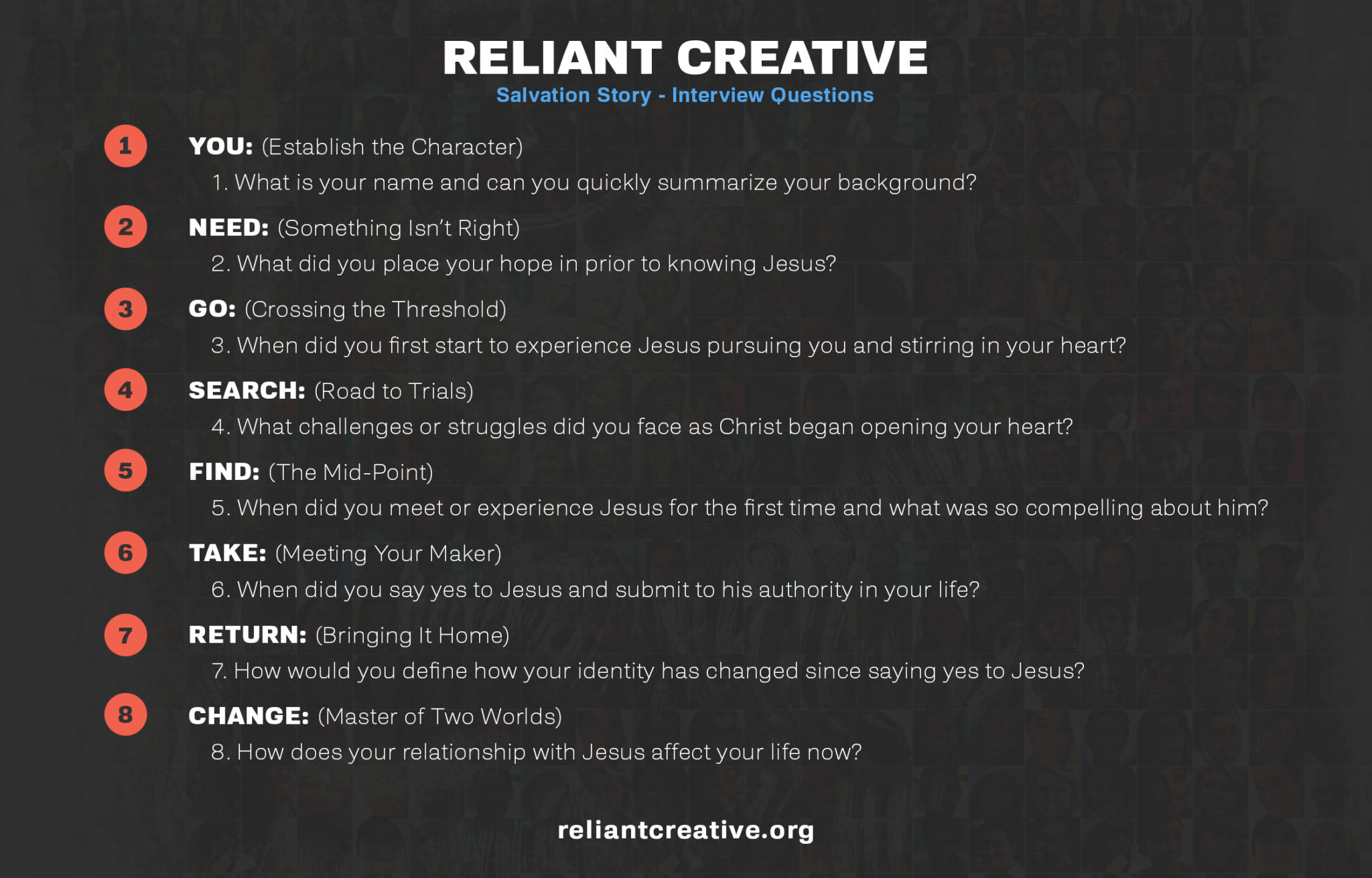
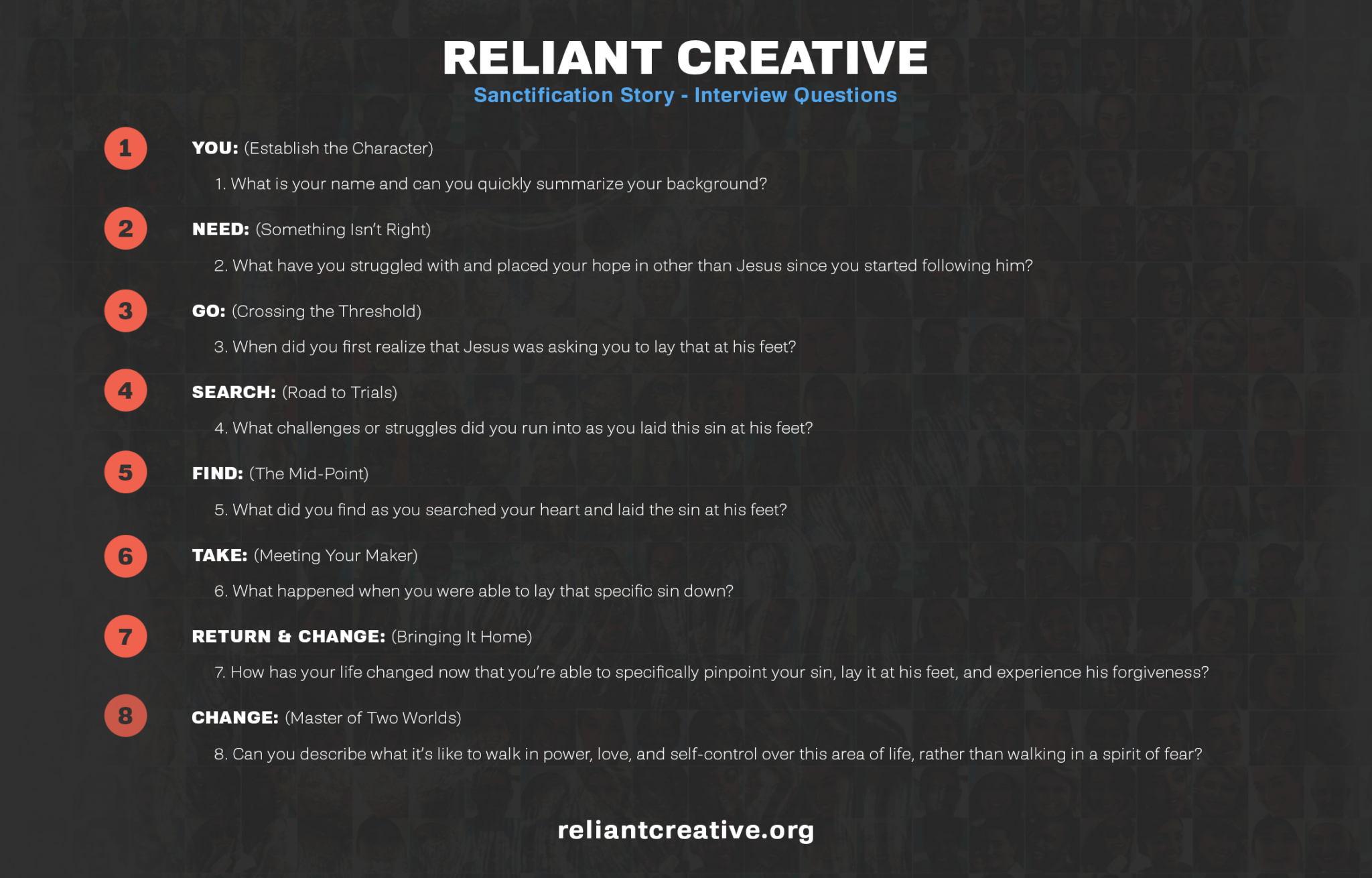
In order for this strategy to work, you have to ask the right questions in the right order. The Hero’s Journey gives us a structure out of which we can develop and write questions that will ensure the story being told is a relatable story. Luckily, we’ve already done all of the heavy lifting and created a few question sets you can use to tell great stories. We’ve got questions for a Salvation Story or a Sanctification Journey Story. Let your storyteller decide what story they want to tell based on the questions they resonate with the most, and then use those questions as the guide for the interview conversation.
If you have a ClickUp account, you can also use this SOP we’ve created for the Kingdom Stories team.
Once the storyteller has selected a time that works for their schedule, you’ll set up your Calendly calendar to send the storyteller an automated email with a link to the Riverside studio you’ve created for your show. One of the nice things about Riverside is that the studio link is always the same, so you can add that automation to Calendly and never think about it again.
Pre-Recording Questions
Once you’ve got your storyteller on the call in Riverside, spend some time getting to know the person. If you already know the storyteller, spend some time catching up. Don’t just jump right into the recording. It’s important that they feel comfortable, that this is a safe environment to share. Sharing a story of death to life transformation is an incredibly vulnerable act. It requires bravery on the storyteller’s side, and empathy and compassion on the interviewer’s side. The goal isn’t to exploit story’s for the sake of a successful content strategy. Your show won’t last long if that’s the approach you take.
The Story Interview/Conversation
This is arguably the most important part of this entire strategy. Remember, most Christians have never shared their story or been trained to share their story. This is where a trained and experienced interviewer is required, or at the very least a guided and story structured set of questions. At Kingdom Stories, in an attempt to make everything as systematized as possible, we’ve created two different guided sets of questions. These question sets with help the storyteller either share their salvation story or a sanctification journey story. Limiting the number of questions asked, and the variation is questions allows our editing team to know exactly what to expect and when to expect it in the editing room. Editing is the biggest time constraint to video production, and therefore the biggest time constraint to any content strategy. We’re doing everything we can with Kingdom Stories to create systems that allow us to share more stories more often.
You can find our questions sets by following these links:
Post-Interview Conversation
Once the interview is complete and you’re done recording, make sure you encourage and thank the storyteller for their bravery and courage. Again, sharing a death to life transformation story is a big deal and requires a lot of vulnerability. Encourage your storyteller in what they’ve just done. You might also consider following up on the security questions just to confirm you haven’t missed anything.
Editing
The editing room is where process can really drag on and hold a consistent content strategy back. As we’ve said before, the reason we’ve gone to such great lengths to systematize our entire process at Kingdom Stories is because the editing process can be so time intensive if you haven’t done pre-production work to simplify the process for the editor.
So, how quickly you get through editing is heavily dependent on everything we’ve already discussed.
Once the recording is finished and the editing process begins, we want to systematize the editing process as well. For Kingdom Stories, the final edit follows this structure everytime:
30-59 Second Hook -> Intro Animation -> Full Interview. We will cut out any awkward pauses or portions of the interview where the storyteller might’ve needed to say something again or in a different way, but for the most part there’s very little editing taking place in the long form content because the questions we’ve asked have guided the storyteller.
Riverside also has the ability to create “markers” during the interview, so the interviewer can mark places for editing while the recording is taking place.
Once the long-form video is complete, the editor will go back through the interview and cut three 0:30 – 0:59 second clips and turn them into vertical video for #shorts, #reels, and #verticals. Riverside also has a tool called “MagicAi”, which uses ChatGPT and the interview transcript to create vertical video shorts from the conversation. These can either serve as additional social content for the strategy, or they can help guide the editor in the vertical video editing process.
The final output in the editing process is as follows:
1x 10-20 minute long-form video
3x 0:30 – 0:59 second vertical videos
1x Image with a Quote Overlay
Assuming your ministry has 5 social platforms and an email list, this editing output will generate over 90 pieces of story-driven, story-first content for your ministry. Now, couple that with the content your ministry is already creating, and you’ve completely solved your annual content strategy problems with a model that leads with story (the content most likely to engage with a digital audience).
Distribute and Promote Testimony Content Across Platforms
Social Media Platforms
Once all of your content is edited and ready for publishing, it’s time to share your content publicly. Rather than sharing all of your content separately on each individual social platform account you own, it’s best to find a social media scheduling platform. This will provide a lot of simplicity and efficiency for your team. We use VistaSocial and feel it’s the best option on the market, and we’ve tested or tried a bunch.
You’ll choose a day that your long form content will get published on and remain consistent to that scheduling day as closely as possible. So, if your long-form videos go out at 2p on a Monday, try to stick to that time and day every week.
You’ll then schedule and publish your vertical videos across all of your social platforms on the days that follow. These “micro content” posts should link back to your long-form content. The goal is to drive traffic to the full story. The schedule will look something like this, and we’ve also created a content strategy map calendar that outlines the entire plan in detail.
Content Schedule
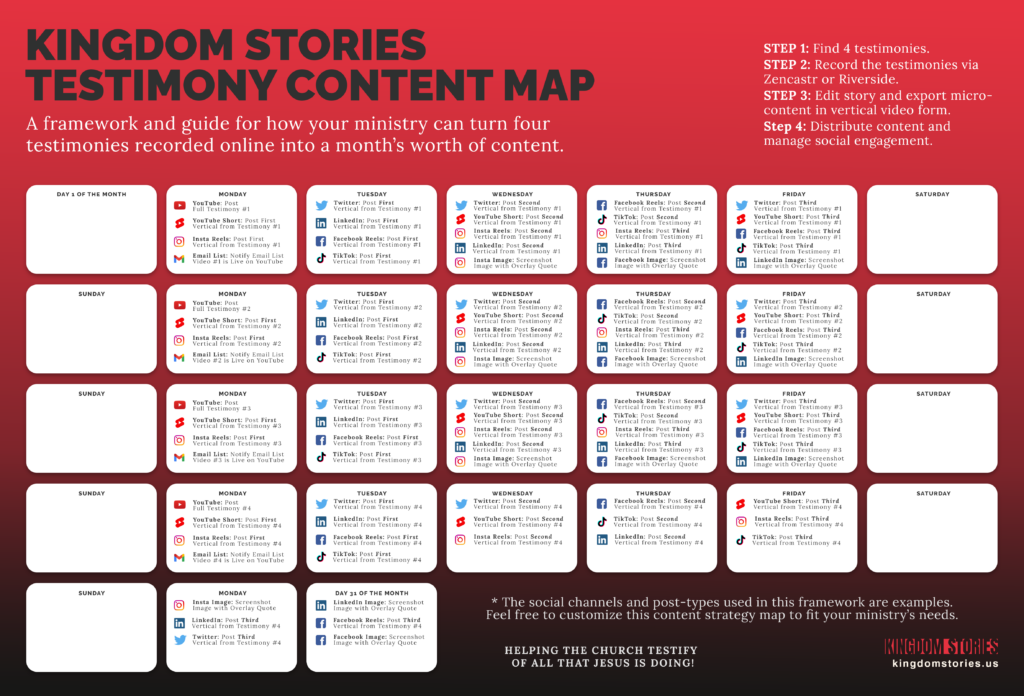
Monday – Long-Form Video – YouTube (and any other platforms that support long-form video)
Tuesday – Vertical Video #1 – All channels
Wednesday – Vertical Video #2 – All channels
Thursday – Vertical Video #3 – All channels
Friday – Image with Quote Overlay – All channels that allow image posts
Create a Testimony Archive Page on Your Church Website
You also might consider creating a landing page or “story archive” on your website where these stories can be held. With legacy social platforms becoming more hostile to Christian content, it might be wise to hold these stories on a platform you control.
Frequently Asked Questions
What is church storytelling and why does it matter for ministry growth?
Church storytelling is the practice of intentionally capturing and sharing stories of transformation happening within your congregation or ministry. It matters because people connect with lived experience more deeply than with announcements, programs, or promotional content. A church that consistently shares testimony builds trust, inspires generosity, and gives its community language for inviting others into what God is doing.
How do we collect testimonies from our congregation?
Start by asking. Most church members have stories of God’s faithfulness but have never been invited to share them in a structured way. Create a simple intake form, designate someone on your team to conduct brief interviews, or set aside time during small groups to listen for transformation stories. The key is building a repeatable system rather than waiting for stories to surface on their own.
How often should a church share testimony content?
As often as you can sustain without sacrificing quality or dignity. Many churches find that one well-told testimony per month, repurposed into social media posts, email content, and sermon illustrations, is enough to anchor an entire content calendar. Consistency matters more than volume.
What is the difference between storytelling and marketing for a church?
Marketing is the vehicle. Storytelling is the fuel. A church marketing plan without testimony feels transactional. Testimony without a distribution plan stays hidden. Church storytelling bridges the two by giving your marketing something real and relational to share rather than relying on announcements and event promotions.
How do we tell stories without exploiting the people in them?
Always prioritize the dignity and consent of the person whose story is being told. Let them review the final content before it is published. Never share details they have not approved. Frame the story around God’s faithfulness rather than the person’s pain. And never use a story primarily to drive donations. If the story serves the person and honors God, it will serve your ministry naturally.
Build a Sustainable Storytelling System for Your Ministry
Church storytelling is not a marketing tactic. It is a discipleship practice.
When your church builds a repeatable storytelling system, you strengthen faith inside your congregation and extend witness beyond it. Stories remind your people what God has done. They also invite others to consider what He might do in their lives.
The goal is not volume. The goal is faithfulness and consistency.
If you want a done-for-you pathway, Kingdom Stories provides a complete, video-first testimony system designed specifically for churches. From interview structure to editing and distribution, it equips your ministry to share more stories, more often, without overwhelming your team.
If you need broader support across messaging, digital strategy, and ongoing execution, our Marketing as a Service (MAAS) partnership provides long-term, hands-on implementation. We don’t just design the plan. We help you build the rhythm.
Start small. Build structure. Tell the stories God is already writing.