
How Story-Driven Messaging Fuels Disciple-Making Movements
Most church growth strategy advice starts in the wrong place. Conferences talk about systems and assimilation funnels. Books prescribe attendance metrics, leadership pipelines, and small-group ratios. Consultants build slide decks around conversion rates and member retention. All of it is downstream of the actual question.
The question is not how to attract more people to your church. The question is how the Gospel actually spreads. And across the world right now, the Gospel is spreading through something simpler than any growth model — story.
Across Africa, India, Southeast Asia, and pockets of Latin America, disciple-making movements are multiplying through ordinary believers sharing ordinary testimonies. No platforms. No production budgets. No celebrity pastors. Just people telling other people what God has done. The fastest church growth on the planet right now runs on storytelling, not on strategy as most Western leaders define it.
This article walks through how disciple-making movements actually grow, why story is the engine of those movements, and what a church growth strategy looks like when it is built around testimony and transformation rather than around systems and scale.
To see the principle in motion, consider the story of Final Command Ministries. Their work over the past two decades helping leaders catalyze multiplication movements in places like Africa illustrates how a story-rooted church growth strategy can transform what a community of believers thinks is possible.
Table of Contents
The Story Behind Final Command Ministries
Final Command Ministries emerged from a simple question.
What would it look like if disciple-making movements multiplied in the West the way they have in other parts of the world?
The ministry was founded by Jerry Trousdale, author of Miraculous Movements, along with Claude King, co-author of Experiencing God. Their vision grew out of conversations about rapid church growth and disciple-making breakthroughs occurring across Africa.
In recent decades, the continent has seen extraordinary growth in Christianity. Today, Africa is home to more than 180 million evangelical Christians.
Much of this growth has come through disciple-making movements—networks of believers who share the Gospel relationally and train others to do the same.
John King, a global coach with Final Command Ministries, has been closely involved in helping leaders understand and apply these principles.
What began as a small initiative has grown into an international movement focused on equipping churches and believers to multiply disciples.
What Is a Disciple-Making Movement?
A disciple-making movement is not a program.
It is a pattern of spiritual multiplication.
Instead of focusing primarily on church attendance or institutional growth, the goal is to equip believers to share the Gospel and disciple others in their own communities.
This approach reflects the early church described in Scripture.
“And the word of God continued to increase, and the number of the disciples multiplied greatly.”
Acts 6:7, ESV
The emphasis is simple.
Followers of Jesus learn to share the Gospel.
New believers are discipled.
Those disciples are trained to disciple others.
Over time, the Gospel spreads through relational networks.
Movements grow not through centralized leadership, but through ordinary believers living out the mission of Jesus.
How Disciple-Making Movements Multiply
While each context is different, most disciple-making movements share several common practices.
Prayer and Spiritual Alignment
Movements begin with prayer.
Leaders seek alignment with God’s direction before launching new efforts or initiatives. Prayer shapes both strategy and dependence.
Without prayer, multiplication becomes a human project.
With prayer, it becomes participation in God’s work.
Finding a Person of Peace
Jesus instructed His followers to look for people who were open and receptive to the Gospel.
These individuals often become bridges into entire communities.
When a person of peace receives the message of Christ, they naturally share it with family members, neighbors, and friends.
This relational dynamic allows the Gospel to spread organically.
Discovery Bible Groups
Discovery Bible groups form the backbone of many movements.
Rather than relying on formal teaching structures, small groups gather to read Scripture together, ask questions, and apply what they learn.
Participants are encouraged to obey what they discover in Scripture and share those lessons with others.
This pattern builds disciples who are active participants rather than passive listeners.
Multiplication Through Testimony
Perhaps the most powerful force behind movement growth is testimony.
Stories of transformation travel quickly. When someone shares how Christ has changed their life, the message carries authenticity and hope.
Testimonies are often the catalyst that inspires others to explore faith for themselves.
Why Story Is the Engine of Kingdom Movements
This is why a church growth strategy built on storytelling outperforms one built on systems. Stories travel through relationships in ways that programs cannot. Stories have always played a central role in how truth spreads.
Jesus often taught through parables—short narratives that revealed deeper spiritual realities.
“I will open my mouth in parables; I will utter what has been hidden since the foundation of the world.”
Matthew 13:35, ESV
Stories reach the heart in ways explanations often cannot.
They help people see how truth takes shape in everyday life.
In ministry communication, stories serve several purposes.
They show how God is at work.
They reveal the impact of the Gospel.
They invite others into the mission.
When people hear stories of transformation, they begin to imagine what God might do in their own lives and communities.
How Ministries Can Use Story-Driven Messaging
Many ministries focus on describing programs instead of telling the story of transformation. They publish updates, statistics, and reports, but the deeper impact of the Gospel can remain difficult for people to see. This is why a thoughtful church growth strategy with a solid messaging structure — supported by clear digital visibility such as strong SEO — has to begin with how the ministry tells its own story.
But audiences often struggle to see the human impact behind the work.
Story-driven messaging changes that.
A thoughtful ministry marketing strategy ensures that stories of transformation are shared clearly and consistently across every channel.
Stories Reveal Transformation
Instead of describing programs, stories highlight people.
They show how lives are changing because of the ministry’s work.
Transformation stories make the mission tangible.
Stories Clarify the Mission
A clear story explains what problem the ministry addresses and how the Gospel brings hope.
When people understand the story, they understand the mission.
Stories Invite Participation
Stories create connection.
Supporters see the difference their involvement can make, and they begin to view themselves as participants in the mission.
This dynamic strengthens both engagement and generosity.
A Simple Story Framework for Your Church Growth Strategy
Ministries do not need complex marketing strategies to communicate clearly. Most ministries already have powerful stories. The challenge is learning how to tell them clearly.
A simple narrative framework often works best.
The Problem
Every ministry exists because a real need exists.
Stories should begin by naming the challenge or struggle people face.
The Invitation
Next, the story introduces the ministry’s response.
How does the Gospel address the problem?
How does the ministry serve people in practical ways?
The Response
Stories then show individuals or communities responding to the invitation.
People step forward. Faith grows. Relationships deepen.
The Transformation
Finally, the story highlights the result.
Lives change. Communities are strengthened. Hope grows.
This narrative pattern reflects the deeper story of redemption found throughout Scripture.
Why Every Church Growth Strategy Needs Story-Driven Communication
In a crowded digital landscape, ministries compete for attention.
But the goal is not simply visibility.
The goal is clarity.
When a ministry communicates clearly, people understand what God is doing and how they can participate. Ministries often assume they need a larger audience to grow their impact. But in many cases the first step is stewarding the people God has already entrusted to the mission.
Story-driven communication helps ministry leaders:
- communicate mission with clarity
- build trust with supporters
- inspire participation
- share the Gospel more effectively
Ultimately, storytelling is not about marketing.
It is about bearing witness to the work of God. And when ministries learn to tell that story clearly, people begin to see where they belong in the mission.
FAQs
What is a disciple-making movement?
A disciple-making movement is a pattern of rapid spiritual multiplication where believers are equipped to share the Gospel and disciple others within their communities.
Why do stories matter in ministry communication?
Stories help audiences understand the real impact of ministry work. They reveal transformation and make the mission more relatable and memorable.
How can churches improve their ministry messaging?
Churches can focus on sharing testimonies, highlighting personal transformation, and structuring communication around clear narratives rather than program descriptions.
Do ministries need professional marketing to tell better stories?
Not necessarily. Authentic stories from real people are often the most powerful communication tools a ministry has.
What is story-driven messaging?
Story-driven messaging communicates a ministry’s mission through real stories of transformation rather than abstract explanations or program descriptions.
How does storytelling help ministry growth?
Stories inspire trust, engagement, and participation by helping audiences see the tangible impact of the Gospel in people’s lives.
Learn to Clarify Your Ministry’s Message
Many ministries struggle to explain their work in ways that resonate with today’s audiences. Developing a clear church growth strategy rooted in story helps leaders communicate the Gospel with clarity while strengthening engagement with their community. Clear communication helps people see the impact of your mission and invites them to participate in what God is doing.
If your ministry wants to strengthen its messaging, storytelling, and digital communication strategy, we would love to help.
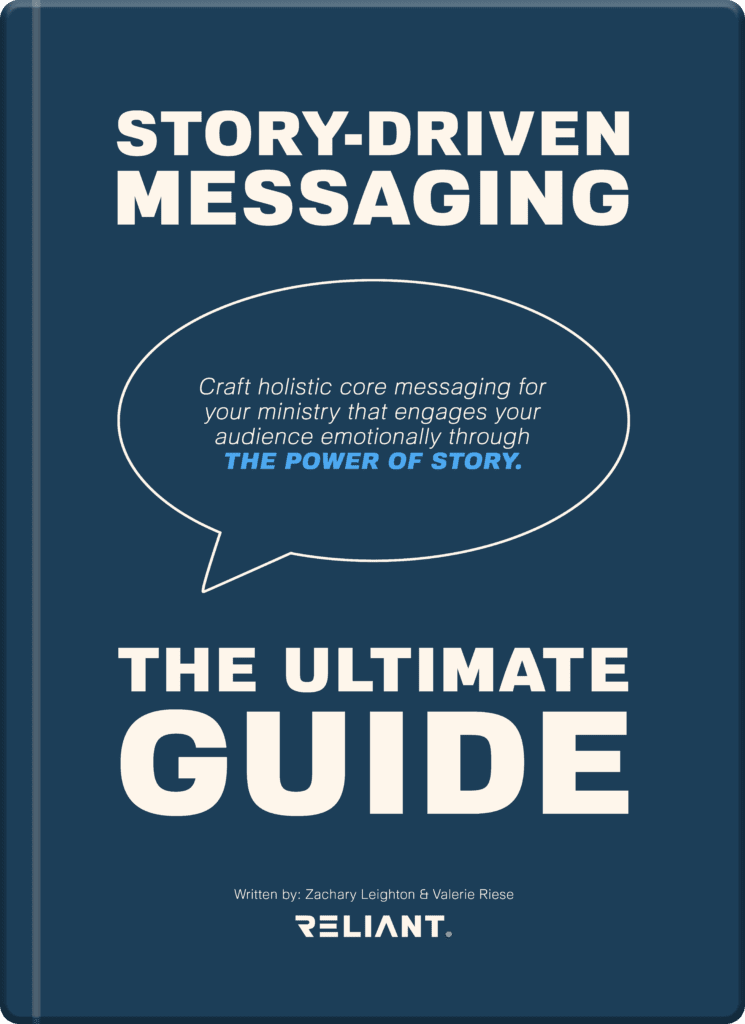
Download the Ultimate Guide to Story-Driven Messaging to learn how to structure transformation stories and communicate your mission with clarity.
Or explore how Reliant Creative partners with churches and Christian nonprofits through messaging strategy, narrative-aligned SEO, and digital storytelling to help ministries reach more people with the Gospel.