Why Ministries Struggle to Recruit and Retain the Right People
Ministry messaging plays a major role in whether churches and nonprofits attract the right people to serve their mission. When expectations are unclear, leaders often recruit people who are passionate but unprepared for the realities of ministry life.
Radius International is a thriving missionary training facility that has found a solution.
A recent poll showed that 42 percent of pastors are struggling with burnout and considering leaving their vocation. The rigors of missionary life take an even higher toll. Nearly 70 percent of missionaries don’t make it more than two years in the field.
Ministries exist to share the Gospel, but constant turnover weakens teams, drains resources, and discourages leaders who entered ministry with deep conviction. The ministry is bogged down by a continued demand on resources for recruitment, training, placement, and acclimation. Besides the strain on the ministry programs, the well-intended servants of God leave ministry damaged and hurting.
In this article, we’ll share what we learned from Radius’s president Brooks Buser about the power of a full disclosure call to action to find and keep the right people, even in the most grueling missionary fields.
If your ministry wants to stop the revolving door and find people with both the heart and the fortitude to endure the trials of ministry life, read on for help from an organization that knows how to close a hard sale with everybody’s best interests at heart.
Table of Contents
The Recruitment Problem: When Ministries Only Tell Half the Story
Ministry often looks inspiring from a distance. Many of us imagine missionary life as a continual walk of faith, serving others while growing closer to Christ.
But that picture is only part of the story.
At least, that’s what the videos at church told me. I’ve just recently discovered this is only half of the story.
This summer, I attended a women’s retreat where some of the ladies were lifelong missionaries, some even from childhood. Their love for the Lord was inspiring, unlike anything I’ve seen before. But as the weekend continued, their stories from the mission field awakened me to a reality of suffering and evil I didn’t know existed.
One woman was a newlywed when she and her husband joined a few other couples to serve in Africa. The church gave them all a hero’s send-off with balloons, choir music, and cheers from the congregation. Within a few months, my friend, her husband, and their new baby were the veteran missionaries, the only ones still left from their group. The family eventually returned to the US where they now struggle with the trauma they all endured, especially the little girl who grew up as the only blue-eyed blond child living an active Voodoo culture.
Guests on The Ministry Growth Show have shared similar stories of trauma, loss, and even death on the missionary field. I’ve learned that the higher the calling, the higher the cost.
Missionaries often serve in spiritually and culturally difficult environments, where isolation, opposition, and suffering are real possibilities. And yet, just like with the government’s military recruitment materials, in many cases we only share rose-colored messaging designed to fill quotas, all while taking advantage of the most sacrificial people at the cost of their future health and well-being.
Organizations that prepare missionaries well understand this tension. They don’t hide the difficulty of ministry—they explain it clearly.
Case Study: How Radius International Prepares Missionaries for Real Ministry
In 2011, a handful of missionary pastors began asking why missionary recruitment efforts were sending people overseas who weren’t making it more than two years. The pastors found that it was because the missionaries had incomplete expectations and training. So, they started Radius International with seven students to “Equip them before we send them.”
The moment an aspiring missionary lands on Radius’s website, the visitor is met with a balance of purpose and reality. Their program page begins with “By definition, the setting is going to be resistant, hostile, difficult, defensive, and immensely challenging.” Their site is full of terms such as high-stress environment, loss of personal rights, and thick-skinned.
Radius students must have a college degree along with a recommendation from their church. The application process also includes a testament to their commitment to complete the 10-month training program in Mexico and their intent to serve in ministry long term.
You’d think such strong language and high expectations would deter people from attending, but Radius’s president Brooks Buser said their messaging actually helps reveal those who are a good fit.
“We find that when you paint the picture for certain individuals in society that this is going to be very difficult, you actually get the right people that stand up and say, ‘we want to do this.’ They want to take the Gospel to where it’s never been before, where there is no Gospel, no disciples, no church. Radius is geared toward that. We find there’s a swath of people that are looking for a serious school that will get them out there.”
Why Honest Messaging Improves Ministry Recruitment and Retention
Ministry leaders often assume that highlighting difficulty will discourage people. In reality, the opposite is often true. Clear expectations attract people who are prepared for the work.
When ministries communicate both the purpose and the cost of the mission, they help future leaders discern their calling before stepping into the role.
This kind of honesty does not reduce interest. It refines it. The people who respond are often the ones most prepared to stay.
How Clear Ministry Messaging Attracts the Right People
Radius finds the right people through clear messaging. Their approach also reflects a thoughtful church communication strategy that aligns expectations with the reality of ministry life. Next, I’ll show you what they’re doing so you can strengthen your own call to action to get the best fit for your mission.
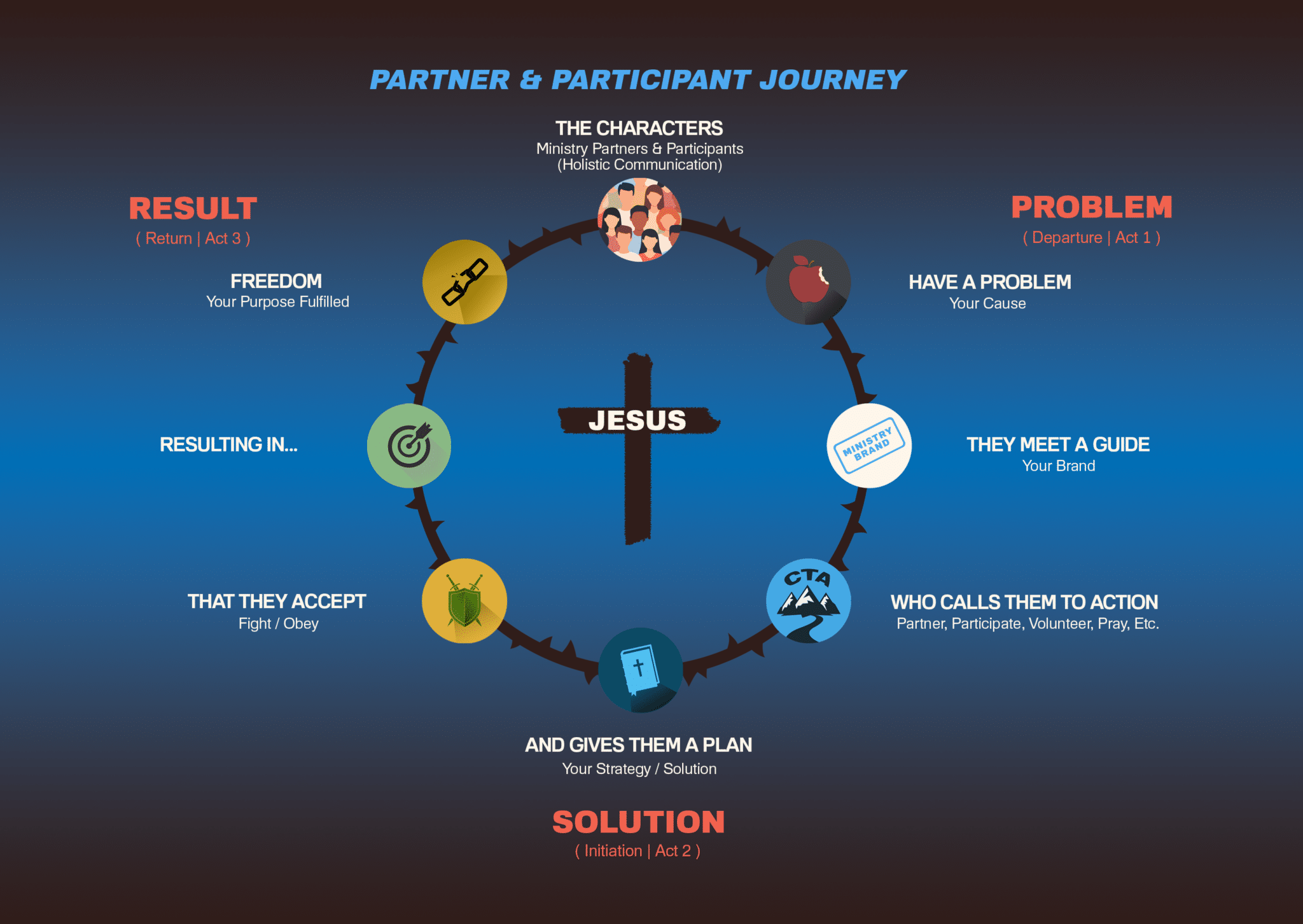
At Reliant, we use our Partner and Participant Journey story script to guide and craft messaging. This framework reflects the power of nonprofit storytelling to clarify mission and invite participation.
For-profit and nonprofit organizations alike often skip the part of the story where they ask the prospect to join them, but this is the piece where Radius has really nailed it. Where many ministries assume the invitation is implied, Radius goes beyond asking them to enroll. They begin equipping missionaries with realistic expectations by telling their audience exactly what they’re joining. Radius’s messaging provides both the sales pitch and the reality. And by giving the full story, they weed out people who aren’t a good fit, so those who are left will last.
You can see how this plays out in our Partner and Participant Journey story script in the graphic below. Radius leverages the full power of the call to action by going beyond simply asking, to telling them exactly what they’re asking for. Their messaging is heavy in the call to action, where the audience is not only asked to enroll, but to enroll for both the glory and the hardship of life in the mission field.
Clear ministry messaging allows organizations to recruit people who understand the mission and the cost involved.
Frequently Asked Questions About Ministry Messaging and Recruitment
Why do ministries struggle to recruit the right people?
Many ministries unintentionally present an incomplete picture of ministry life. When expectations are unclear, people enter ministry without understanding the emotional, spiritual, and logistical demands.
Does honest messaging discourage people from serving?
Often it does the opposite. When ministries clearly communicate the realities of ministry life, they attract people who feel genuinely called and prepared for the work.
What is a strong call to action in ministry communication?
A strong call to action clearly invites someone to take a specific step — joining a program, supporting a mission, or exploring a calling — while explaining both the opportunity and the commitment involved.
How can storytelling help ministries recruit better leaders?
Story helps people understand the purpose behind the mission. When ministries share real stories about impact, challenges, and calling, people can better discern whether they belong in that story.
Why do missionaries leave the field early?
Common reasons include unrealistic expectations, lack of preparation, cultural stress, isolation, and insufficient support structures.
What role does messaging play in ministry growth?
Clear messaging helps ministries communicate their mission, attract aligned leaders, and invite supporters who resonate deeply with the work.
Clarify Your Ministry Story So the Right People Respond
Every ministry is inviting people into a story.
When that story is unclear, the wrong expectations form. Teams struggle. Leaders burn out. And the mission suffers.
But when ministries communicate the full picture — the purpose, the challenge, and the calling — something powerful happens. The people who respond are often the ones who are ready to stay.
At Reliant Creative, we help churches and Christian nonprofits clarify their message so the right people understand what you do, why it matters, and how they can participate.
If your ministry wants stronger alignment between your mission and the people who join it, start with our free resource:
Download: The Ultimate Guide to Story-Driven Messaging
This guide will help you:
- Clarify your ministry message
- Strengthen your calls to action
- Communicate your mission with confidence
Download the guide and begin strengthening the story your ministry is telling.