
A Practical Digital Marketing Guide for Ministry Leaders
Church digital marketing is no longer optional for ministry leaders. Churches searching for growth, clarity, and stronger community engagement need a strategic digital presence. Whether you are evaluating a church marketing agency or building an in-house team, your digital strategy directly impacts how people find and experience your church.
In this article, we will explore how church digital marketing works in practice, including the tools, platforms, and tactics that help ministries grow their reach. If you are looking for a broader framework first, our guide to building a church marketing strategy covers audience, messaging, and planning before you choose your tools.
Table of Contents
How to Choose the Right Church Marketing Agency
Church leaders are not just looking for tactics. They are looking for partners who understand ministry.
If you are evaluating a church marketing agency, look for:
- Experience serving churches and Christian nonprofits
- Clarity in messaging and theological alignment
- Proven church website and SEO case studies
- Google Ad Grant expertise
- Long-term strategy, not one-off campaigns
The right agency does more than run ads. It helps your church communicate clearly and reach people with integrity. For a deeper look at what makes a Christian marketing agency genuinely different from a secular firm, and why that distinction matters for your church, we break that down in a separate guide.
What Is Church Digital Marketing?

Digital marketing encompasses all online efforts made by churches and ministries to promote their services, events, and messages. It involves the use of various digital tools and strategies to engage and grow a congregation while creating an impactful online presence.
A strong online presence is crucial in the digital age. People increasingly turn to the internet to find information about local services, including church services. Your church’s online presence not only provides information about your church but also establishes credibility and trust. It can be a powerful channel for newcomers to learn about your church’s values and services.
Church Digital Marketing Foundations
A strong church marketing strategy includes website design, local SEO, content development, Google Ad Grant management, email systems, and paid advertising. When these elements work together, churches increase visibility and reach people actively searching for spiritual community.
You need to have a number of things in place to be successful in growing a solid church digital marketing program. Here are some of the foundations churches need in place to successfully market their ministry:
Building a Church Website That Welcomes Visitors
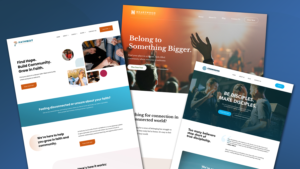
A well-designed church website serves as the virtual front door of your church. It’s essential to ensure that it’s user-friendly, mobile-responsive, and filled with engaging content. An excellent church website should include service times, information about upcoming events, and a section for visitors to learn about your church’s beliefs and values. Many ministry leaders partner with a church website design agency to ensure their site reflects their theology, mission, and local community.
Your website serves as the virtual front door to your congregation, visitors, and seekers. In today’s world, your online presence can often be the first point of contact for anyone curious about your church. To make it effective you need the following basic elements:
- A Well-Designed Website: Ensure your website is user-friendly, mobile-responsive, and visually appealing.
- Digital Content: This is arguably the single most important piece to your digital marketing strategy, and often the single most ignored aspect of the plan. Regularly update your online content to keep visitors engaged and informed. Both website design and content should underscore your ministry’s core story, show your core values, and show the fruits of your ministry.
- Analytics: Use analytics like GA4 to better understand your church website visitors and their behavior on your site.
Local SEO for Churches: How to Be Found in Your Community
When churches search for a digital marketing agency, local SEO is often one of the first needs. Ranking for terms like “church near me” or “church in [city]” requires intentional on-page optimization and Google Business Profile management.
Search engine optimization (SEO) is a vital aspect of church digital marketing. By optimizing your website with relevant keywords and quality content, you improve your chances of appearing on the first page of search engine results.
Optimize Your Google Business Profile
For churches aiming to engage with their local communities, local SEO is also invaluable. Local SEO (Search Engine Optimization) plays a crucial role in ensuring your church is discoverable in search results. It focuses on optimizing your online presence to make your church more visible in local searches.
A Google Business Profile is an essential part of local SEO for churches. Ensure your profile is complete and accurate. It should include your church’s name, address, phone number (NAP), service times, photos, and a brief description. This information helps Google understand your church’s relevance to local searches.
Keep NAP Information Consistent
Maintaining consistency in your NAP listings is critical. Ensure that your church’s name, address, and phone number are consistent across all online directories, social media platforms, and your website. This consistency reinforces your church’s credibility in the eyes of search engines.
Encourage and Manage Online Reviews
Online reviews play a significant role in local SEO. Encourage your congregation and visitors to leave positive reviews on platforms like Google, Facebook, and Yelp. Positive reviews enhance your church’s reputation and boost its visibility in local search results.
List Your Church in Online Directories
Listing your church in online directories and local business listings is essential. This increases your church’s digital presence and ensures that people searching for local services can easily find your church.
Create Location-Based Content
Creating location-specific content on your website can also improve your local SEO. For instance, publishing blog posts or articles about local events, community involvement, or services can help you rank higher in local search results.
Church Social Media Strategy That Builds Community
Church social media marketing can be a challenge, but it’s worth the effort. Your congregation is likely already present on platforms like Facebook, Instagram, and Twitter. Use these platforms to share engaging content, provide updates on church services and events, and establish an online community. Things to think about when using social media:
- Social Media Branding: Maintain consistent branding across your social media platforms.
- In-Depth Audience: Understand the demographics and preferences of your social media viewers to craft more tailored content.
- Content: Share content that showcases your church’s values and community life. Highlight the testimonies of your people. God is at work, He’s providing all the content you could ever need, simply document what He’s doing in and through the lives of your people.
- Larger Audience: Use social media to extend your reach and connect with a larger audience beyond your immediate congregation.
- Real Audience: Engage in meaningful conversations and build genuine relationships with people on social media.
Email Marketing for Churches: Nurturing Your Congregation
Email marketing remains a reliable tool for nurturing connections and conveying crucial information to your congregation. You need to outline outline your email campaigns, specifying the goals, content, and target audience for each one. Foster a personal relationship with your subscribers. Offer exclusive resources, such as downloadable e-books, to incentivize subscriptions.
Segmenting Your Church Email List for Better Engagement
Segmenting your email list can help improve the effectiveness of your email campaigns. Send tailored content to specific groups within your congregation to keep them engaged and informed. This makes your emails more personable and results in a better conversion rate.
Digital Advertising for Churches: Google Ads and Beyond
Many churches seek a Google Ad Grant management agency because compliance requirements and optimization standards have become more rigorous in recent years. Active management is no longer optional.
Digital marketing for churches encompasses a wide array of strategies, but Google Ads stands out as a powerful tool to reach individuals actively seeking church services in your area. Google Ads allows you to create and manage online advertising campaigns, putting your church’s message in front of those who are searching for spiritual guidance, services, or community in your locality.
How to Set Up Google Ads for Your Church
Before you can benefit from Google Ads, you need to set up your account. Here are the key steps to get started:
1. Keyword Research: Begin by conducting thorough keyword research. Select keywords and phrases relevant to your church’s mission and services. These keywords will be the foundation of your Google Ads campaign.
2. Budget Allocation: Determine your budget. The Google Ad Grant can provide financial support, but it’s essential to establish your budget based on your specific goals and the competitiveness of the keywords in your area.
3. Ad Creation: Craft compelling ad copy that reflects your church’s unique selling points and mission. Your ad copy should resonate with people searching for church services.
4. Geographic Targeting: Use Google Ads’ geographic targeting options to narrow down your ads’ reach to your specific area. This ensures your ads are seen by the audience most likely to attend your church.
5. Ad Extensions: Take advantage of ad extensions to provide additional information to potential visitors. These extensions can include your service times, contact information, and direct links to relevant pages on your website.
6. Ad Scheduling: Set specific times for your ads to appear. This allows you to ensure your ads are visible when your target audience is most active online.
Using Google Ads to Reach People Searching for a Church
Google Ads provides an opportunity for churches to reach potential attendees at the moment of their search. Whether someone is looking for a local church, spiritual guidance, or specific church events, your ads can be a powerful tool to connect with them.
What Is the Google Ad Grant for Churches?
The Google Ad Grant is a program that provides eligible nonprofits, including churches, with free advertising credit to use on the Google Ads platform. With an impressive monthly budget of $10,000, this grant can significantly boost your church’s online visibility. If you’re interested in learning more about how you can acquire the Google Ad Grant, be sure to check out our free course, Google Ad Grant Acquisition, where we walk you through the entire process and share everything you need to know.
As of recent program updates, churches must maintain a minimum 5% click-through rate, use approved keyword strategies, and avoid single-word or overly generic terms. Ongoing optimization and reporting are required to remain compliant.
How to Use the Google Ad Grant Effectively
The Google Ad Grant is a valuable resource for churches looking to promote their services and events. It offers up to $10,000 per month in free advertising, allowing you to maximize your reach without additional costs. However, it’s essential to manage the grant actively to achieve the desired results.
Why the Google Ad Grant Requires Active Management
While the grant is generous, it requires active management. Properly managing the Google Ad Grant means staying within the program’s guidelines, ensuring your ads align with Google’s policies, and regularly optimizing your campaigns for the best results. This may involve:
- Keyword Management: Continuously refine your keyword list to target the most relevant search queries.
- Quality Score Improvement: Work on enhancing the quality of your ads and landing pages to improve your ad’s performance.
- Monitoring and Reporting: Regularly check the performance of your ads, review click-through rates, and adapt your strategy as needed.
- Ad Copy Testing: Experiment with different ad copy to determine what resonates most with your target audience.
Retargeting for Churches: Bringing Visitors Back

Retargeting allows churches to reconnect with website visitors through Google Display, YouTube, and social media platforms. With updated privacy standards and consent-based tracking, churches must implement compliant tracking systems while maintaining clear communication with their audience.
How Retargeting Works
Retargeting, often referred to as “remarketing,” operates on a simple premise. It involves placing a small piece of code, known as a pixel, on your website. This pixel tracks the online behavior of your website visitors, allowing you to create a custom audience of individuals who have already interacted with your site.
Setting Up Retargeting
To set up retargeting for your church’s website, follow these steps:
1. Pixel Installation: Install a retargeting pixel provided by popular platforms like Google Ads, Facebook, or other advertising networks. This pixel will track visitors’ actions on your site.
2. Custom Audience Creation: After the pixel is installed, create a custom audience based on specific actions. For instance, you can target those who visited your “Upcoming Events” page or “Services” page.
3. Ad Creation: Craft engaging ads that will be displayed to your custom audience. These ads can be used to remind past visitors about church events, services, or other relevant content.
4. Campaign Launch: Launch your retargeting campaign, specifying your target audience and ad creatives.
Maximizing the Potential of Retargeting
To make the most of retargeting for your church, consider the following strategies:
Frequency and Timing
Optimize the frequency and timing of your retargeting ads. Avoid bombarding users with too many ads, which can be counterproductive. Also, ensure your ads are displayed at times when your target audience is most likely to be online.
Tailored Messaging
Craft personalized messages that resonate with your audience. Acknowledge their prior interaction with your church and offer content or invitations that align with their previous interests.
Tracking and Analysis
Continuously monitor the performance of your retargeting campaigns. Analyze click-through rates, conversion rates, and engagement metrics to refine your strategy over time.
A Holistic Approach
Retargeting should be part of a broader church marketing strategy. Integrate it with other digital marketing efforts, such as email marketing, social media, and website optimization, for a cohesive and effective approach.
Clear Calls to Action That Help People Take the Next Step
Finally, clear and effective Calls to Action (CTAs) on your church website, social, and elsewhere can guide visitors to take the next step, such as planning a visit or pre-registering for events. These CTAs play a crucial role in converting website traffic into engaged congregation members.
Whether it’s directing people to your website, inviting them to a special event, or encouraging them to learn more about your church, a well-defined CTA guides the audience on the desired action.
What Ministry Leaders Should Expect from a Church Digital Marketing Agency
A qualified church digital marketing agency should provide:
- Messaging clarity rooted in your theology
- Church-specific SEO strategy
- Google Ad Grant compliance and reporting
- Conversion-focused church website design
- Data tracking with GA4 and clear reporting dashboards
- Long-term strategic partnership
Church marketing is not about hype. It is about stewardship.
Church Marketing Strategy Checklist for Ministry Leaders
- Clarified message
- Optimized church website
- Local SEO configured
- Google Business Profile active
- Google Ad Grant compliant
- Email system segmented
- Retargeting installed
- Analytics (GA4) configured
Why Churches Hire a Digital Marketing Agency
Even when the right systems are in place, many churches eventually outgrow internal capacity. Hiring a church digital marketing agency allows your team to focus on discipleship while specialists manage SEO, website performance, Google Ads, and long-term strategy.
Churches typically seek agency support when:
- Website traffic plateaus
- Google Ad Grant compliance becomes complex
- Growth goals outpace internal capacity
- Messaging feels unclear
- Local search rankings decline
Frequently Asked Questions About Church Digital Marketing
What is church digital marketing?
Church digital marketing refers to the online strategies churches use to reach their community—through websites, SEO, social media, email, and paid advertising.
Why does my church need local SEO?
Most people search online before visiting a church. Local SEO helps your church appear when someone searches “church near me” in your city.
What is the Google Ad Grant for churches?
The Google Ad Grant provides eligible nonprofits up to $10,000 per month in free Google Ads to promote services, events, and outreach.
Is social media necessary for church growth?
Social media isn’t a replacement for discipleship, but it is a tool for visibility, communication, and community engagement.
How often should a church send emails?
Most churches benefit from weekly updates and occasional segmented emails for ministries or events.
What is retargeting and should churches use it?
Retargeting shows ads to people who previously visited your website. It can help remind visitors about services, events, or next steps.
Partner with a Church Digital Marketing Agency That Understands Ministry
Your church deserves more than generic marketing advice.
If you are searching for a church digital marketing agency that understands theology, discipleship, and long-term strategy, Reliant Creative partners with churches and Christian nonprofits to build clear, sustainable growth systems.
We help ministry leaders through:
If you are evaluating a church marketing agency and want a partner who understands ministry culture, spiritual formation, and long-term digital strategy, we would be honored to serve you. You can also explore our complete church marketing strategy guide for the framework behind these tactics.