What Is a Story in Christian Ministry?
At its core, Christian storytelling for churches is the practice of communicating real conflict that leads to transformation through Christ.
Christian storytelling for churches is not about reporting events or listing milestones. It is about conflict that changes life. In April, I watched “His Only Son” in theaters with my best friend, and I witnessed that kind of transformation unfold before my eyes.
At the beginning of the movie, the producer shared the miracle of how the film was done so well on such a small budget. He asked viewers to stay seated after the credits so he could share his plans for future biblical films.
Friends, tears stream down my face as I tell this story. Four ladies sat in the theater recliners to my right. As the movie ended and the credits began, one woman rushed to her friend seated next to me, sobbing, “I understand now, and I’m not scared anymore.”
She kneeled in front of her friend, who wrapped her in an embrace while two other women hugged her shoulders from behind. The woman’s shoulders shook as she continued to sob, “I’m not afraid anymore. I get it now.”
A movie did this. No sermon, no study, no altar call. Just a story, pure as could be, released this woman from a fear so debilitating that her entire body was overcome by its release. Even though I know nothing else of this woman’s story, I’m in tears as I share her transformation witnessed as a bystander a month ago.
As content creators with a calling to use our words for Jesus, isn’t this what we all want? How can we tell stories that transform people’s lives for Christ?
The simplest definition of a story is conflict changes life. For churches and Christian nonprofits, story is death-to-life transformation through Christ.

We consume stories all day, and each story touches us differently. We may laugh, cry, scream, or just escape for a bit. But what is different about a story that not only allows us to escape but transforms us so we never have to return to bondage?
We’ll begin by defining what a story is not and what it is. We will then explore the difference between a story that entertains, and a story that transforms a life.
What Storytelling Is Not in Churches and Nonprofits
A story is not a step-by-step process, an organizational hierarchy of who does what in the ministry, or a chronological list of events. A story is not written to inform your audience about past or upcoming events, nor is it an educational sermon or Bible study. Here is a little more information about the types of content that are meant for purposes other than inspiration or life transformation.
Storytelling Is Not a Ministry Process Document
A process is a series of step-by-step instructions, such as a recipe. No matter how hard food bloggers try to turn recipes into stories, at the end of the day, it’s still just a list of supplies and steps.
Storytelling Is Not an Organizational Chart
A hierarchy is an outline graphic of a chain of command. An organizational chart tells me who is in charge of what, but it does not tell me the story of your company.
Storytelling Is Not a Timeline of Events
A chronology is a list of facts showing who, what, when and where arranged in date order. Many people tell so-called stories as a chronology. It’s the old-school method of teaching history we barely heard between naps. Here’s an excerpt from Storynomics written by Robert McKee that I think is applicable for ministry leaders to hear. “Other executives, when asked to tell their company’s [ministries] story, recite their company’s history. But a corporation’s chronology, especially the kind found in investor prospectuses, is, once again, just another process. In this case, it’s a temporal one told as a list of growth marks accumulated over the sequence of dates.” Story is not a chronology.

Storytelling Is Not Vague “Journey” Language
According to storytelling legend Robert McKee, the word journey is a “euphemism used to separate the mind from the unpleasant realities around it.” Even if they can’t articulate it, anyone who has ever had cancer, buried a spouse or child, or gone through a divorce knows the difference between their journey and their story, and so does their audience. The traveler in a journey simply progresses from point A to point B. A dynamic character struggles through to a better reality.
Not Every Narrative Is a Story
All stories are narratives, but not all narratives are stories. The four previously listed misnomers are narratives—flat boring recitations of events. If you are bored by a story, then you are most likely enduring an oral sequence of “Then I did this, and then I did that. And then I did the other thing. And then, and then, and then…”

Storytelling Is More Than Information
Informational content feels like news. It’s a report, chronology, or discussion of events. If the purpose of the content is to advise or discuss when, where, or who, then it’s probably informational.
Storytelling Is Not a Teaching Outline
Educational content is created to teach the audience something new or solve a problem. It may be a step-by-step guide or how-to article. If the purpose of the content is to answer how or why, then it’s probably educational.
The Classic Definition of Story Structure
Just like building a house, a story is defined by the elements and structures that create the desired result. The most effective storytelling structure is the Hero’s Journey, defined as “A character with a problem meets a guide who gives them a plan and calls him to action. He accepts the call, overcomes trials to reach his goal and emerges as a better person.”
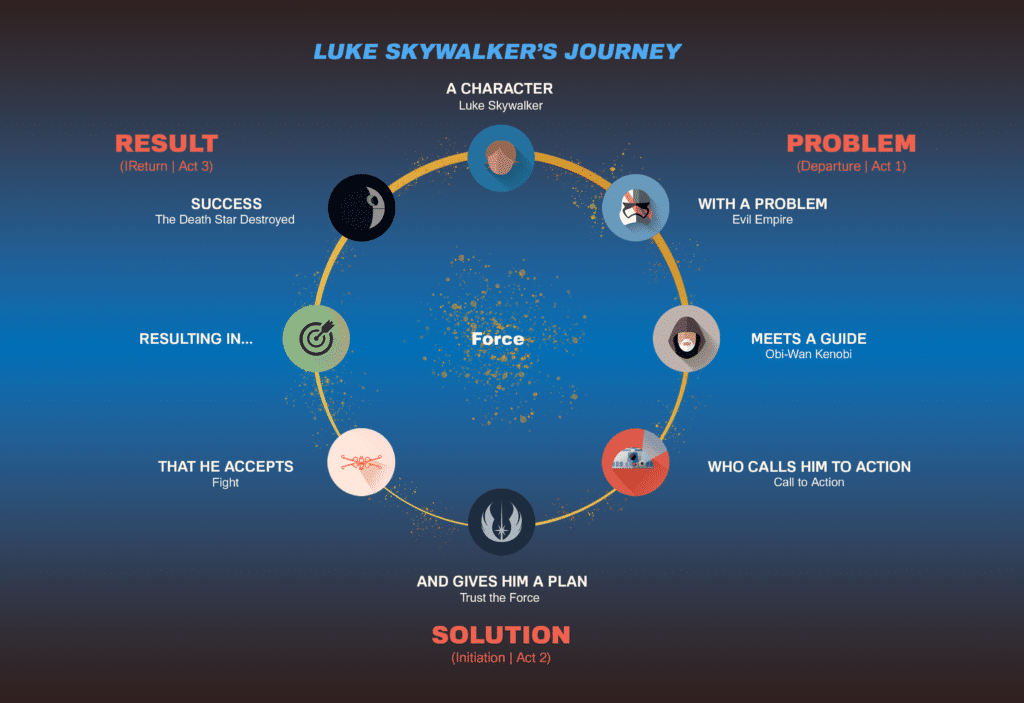
You can write about a character with a problem who finds help to overcome and becomes a better person but still ends up with a chronology or flat narrative because this is just the framework. A powerful story goes deeper than information or education to touch the heart. That’s why a good movie makes us laugh, cry, scream, and escape from life for a little while.
Hollywood recognizes Robert McKee as one of the greatest storytelling coaches ever. We quoted him earlier in this article. He defines a story in three words: “Conflict changes life.” A story has a conflict and a transformation that leads to a new life. We identify with the character in their transformation, so we identify with their values and judge them as either right or wrong.
The Biblical Definition of Story: Death to Life Through Christ
Most films are created as entertainment, so the conflict and change apply to the life of the character. But stories of transformation change the life of the audience.
If the story is about laughter, it makes us laugh. If it’s about sadness, it makes us cry. And if it’s about death-to-life transformation through Christ, then it inspires us to give our conflict to Jesus, so He can change our life. The audience sees that they too can transform, and that’s what the church is trying to do.
Transformative stories are value-charged and progressive. To turn it into a story a person can hang their heart on, you need tension, movement, and transformation. You need values and emotion.
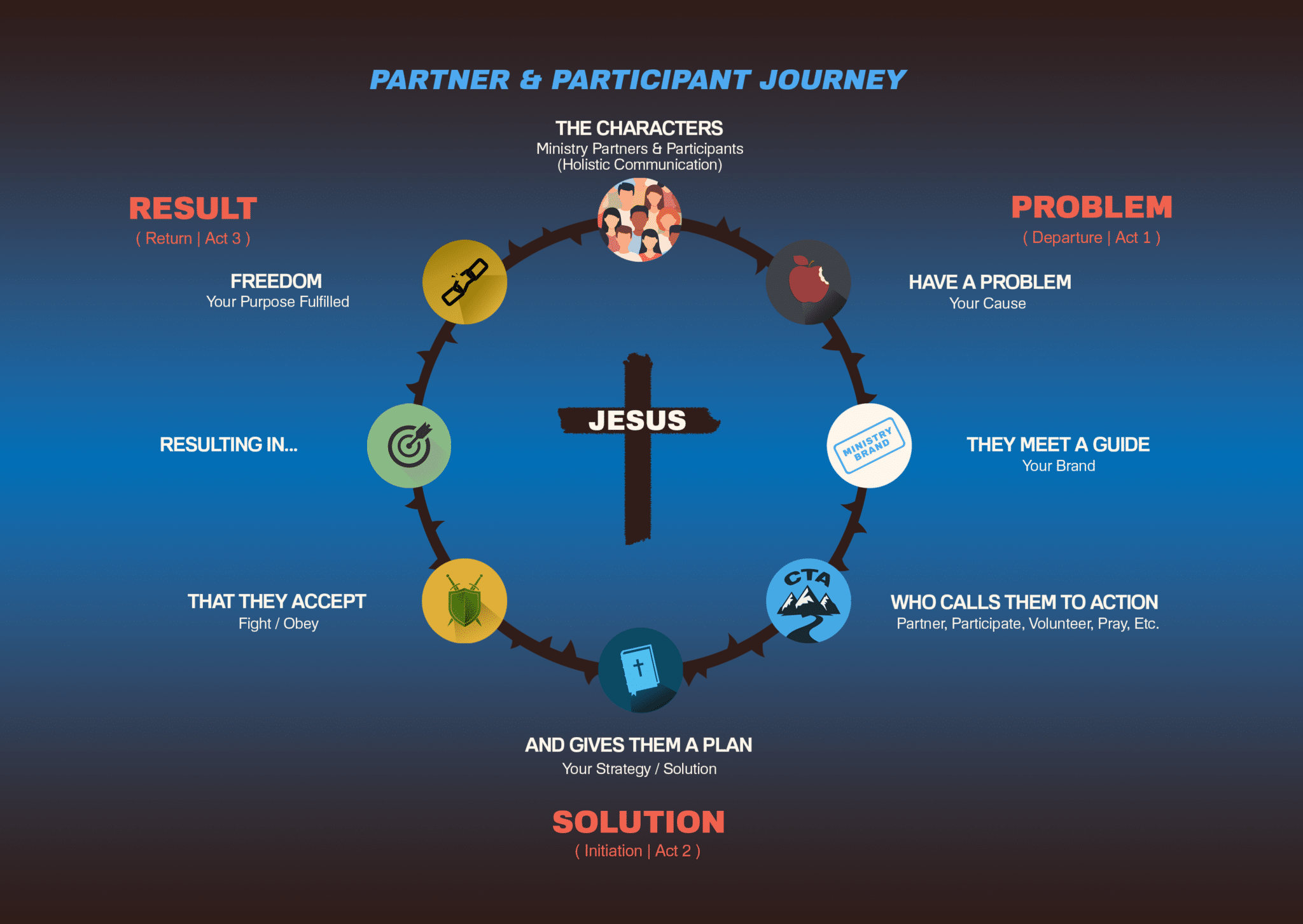
Throughout the Bible, there’s constant tension through conflicts and challenges because of sin, followed by God transforming His children into a new life with Him. This is the story of our lives, the rhythm in which we live over and over again. Each of us who calls ourselves followers of Christ has gone through this process because we share in His death and resurrection.
The simplest definition of a story is conflict changes life. Within the Christian ministry and church space, the simplest definition of a story is death to life transformation through Christ.
Frequently Asked Questions About Storytelling for Churches
What is the definition of storytelling in ministry?
Storytelling in ministry is the communication of real conflict that leads to transformation through Christ. It is not information or education alone; it is change.
Why is storytelling important for Christian nonprofits?
Because people respond to transformation, not reports. Stories help supporters see how God is at work and how they can participate.
What makes a story transformative instead of entertaining?
A transformative story reveals conflict, tension, and meaningful change that reflects gospel truth.
Is a testimony the same as a story?
A testimony is a type of story. It becomes powerful when it clearly shows movement from bondage to freedom in Christ.
What are common storytelling mistakes churches make?
Listing events. Reporting information. Avoiding tension. Using vague “journey” language without real conflict.
How can our ministry improve its storytelling?
Clarify the conflict. Show transformation. Focus on one person. Tie the change directly to Christ.
Building a Christian Storytelling Framework That Changes Lives
Stories change lives when they clearly show conflict and Christ’s transforming work.
If your ministry struggles to communicate transformation in a way that engages both hearts and minds, we can help.
At Reliant Creative, we help churches and Christian nonprofits clarify their message through story-driven strategy, narrative-aligned SEO, and digital execution.
Start with a messaging clarity session and let’s build a story your community can believe in.